A reaction time test is usually one thing: press when it turns green. Mine was too. I have now split it into seven modes, so here is what each one is actually measuring.
I did not add them to have more features. I added them because a single number only tells you fast or slow. "Slow to react" can mean you were slow to notice the signal, slow to decide which way to move, or unable to hold back when you should not have moved at all. Those are entirely different problems.
One mode cannot tell you what was slow
Reaction time is not one ability. It is the sum of the time to notice the signal, the time to decide what to do, and the time for the body to start moving. That decomposition is old: it goes back to the subtraction method proposed by Donders in the nineteenth century — make the task gradually more complex, and read the intermediate processing time off the difference.
Current research still uses the same procedure. In a study where 1,466 people aged 18–65 did both a simple press task and a discriminate-then-press task on the same day, simple reaction time averaged 231 ms, while choice reaction time averaged 476 ms in the youngest group and 595 ms in the oldest. The difference — what the authors call central processing time — averaged 319 ms, and accounted for more than 80% of the age-related slowing.
So splitting the tool into modes means switching which part of that sum you are looking at. Here are the seven.
Classic — isolating simple reaction time
The screen turns green, you press. Nothing to judge, so what comes out is close to the time from noticing the signal to the body moving.

For a reference point: a study of 1,469 people aged 18–65 on calibrated hardware reported a mean of 231 ms, or 213 ms once the hardware delay was subtracted. In the same study, the stimulus detection time — reaction time minus the movement-initiation component derived from a finger-tapping task — averaged 131 ms, and that part showed no effect of age. What slows down with age is the moving, not the noticing.
You often see "0.2 seconds is average" quoted. The value moves a good deal with the apparatus and the method, and anything measured in a browser carries the delay of the screen refresh and the input handling. Rather than comparing against someone else's number, use your own best on the same device.
Sound only — measuring without the screen
The signal is a sound. You do not need to look at the screen, so this works with your eyes closed or with the screen out of view.
Responses to sound come out faster than responses to light. In a study of 120 medical students measured with the same software, auditory reaction time was significantly shorter than visual reaction time for both sexes. In a study of sprint starts measured with force sensors, five of nine athletes averaged under 100 ms in at least one condition.
But the reason this mode exists is not the comparison. It is so that someone who cannot see the screen well can do the same task. A test with only a visual signal creates a group of people it simply cannot measure.
Colour only — measuring without sound or vibration
The inverse. No sound, no haptics — the signal is a change of colour and symbol.
A change of colour can be hard to read depending on your colour vision, so this mode does not rely on colour alone: the shape changes at the same moment. It stays usable in black and white, and therefore across colour-vision types.
Both modes exist because for some people one of the two channels is unavailable. Records are kept separately per mode, so you can simply stay with whichever suits you.
Feint — measuring the not-pressing
False signals are mixed in. Press on the real signal; do not press on the false one.

This looks at something different from pressing quickly. Holding a response back is called inhibition, and it has its own family of tasks. The awkward part is that when you succeed, no response appears — so the speed of stopping cannot be observed directly. A consensus guide written by more than forty researchers describes this latency as a covert variable that has to be estimated with a model.
The same guide notes that "never releasing the response" and "cancelling one already under way" may rest on partly different neural substrates. This mode is closer to the former. The number comes out as a reaction time, but what it means is nearer to whether you can avoid pressing by mistake than to how fast you are.
Left/right — the cost of choosing
An arrow appears and you press the matching side. The gap between this and Classic is the time it took to discriminate and decide.
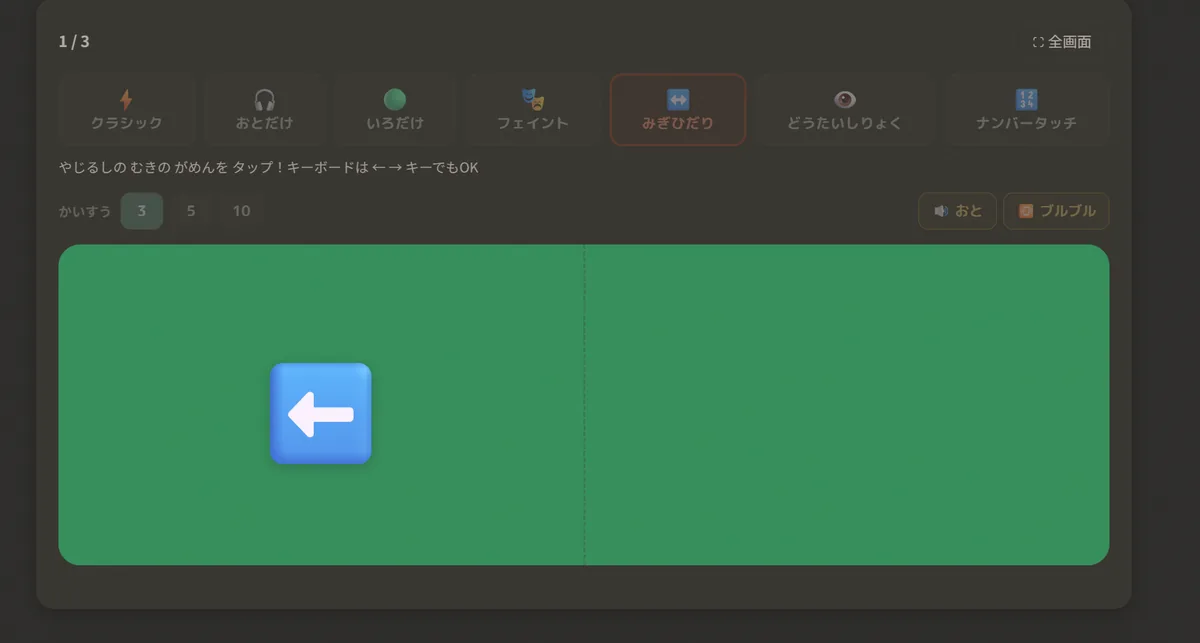
That reaction time grows with the number of alternatives is known as the Hick–Hyman law, and it still replicates. Recent work has amended it, though: stimulus uncertainty and response uncertainty had been confounded, and when they are separated, response uncertainty can account for most of the effect. "Hard to tell apart" and "unsure which finger to use" are not the same problem.
Putting your Classic and Left/right records side by side shows which of the two weighs more for you. A small gap means the deciding is quick; a large one means that is where the room is.
Dynamic vision — reading an instant
A number appears for a moment and you read it. Twelve stages, each shorter than the last.
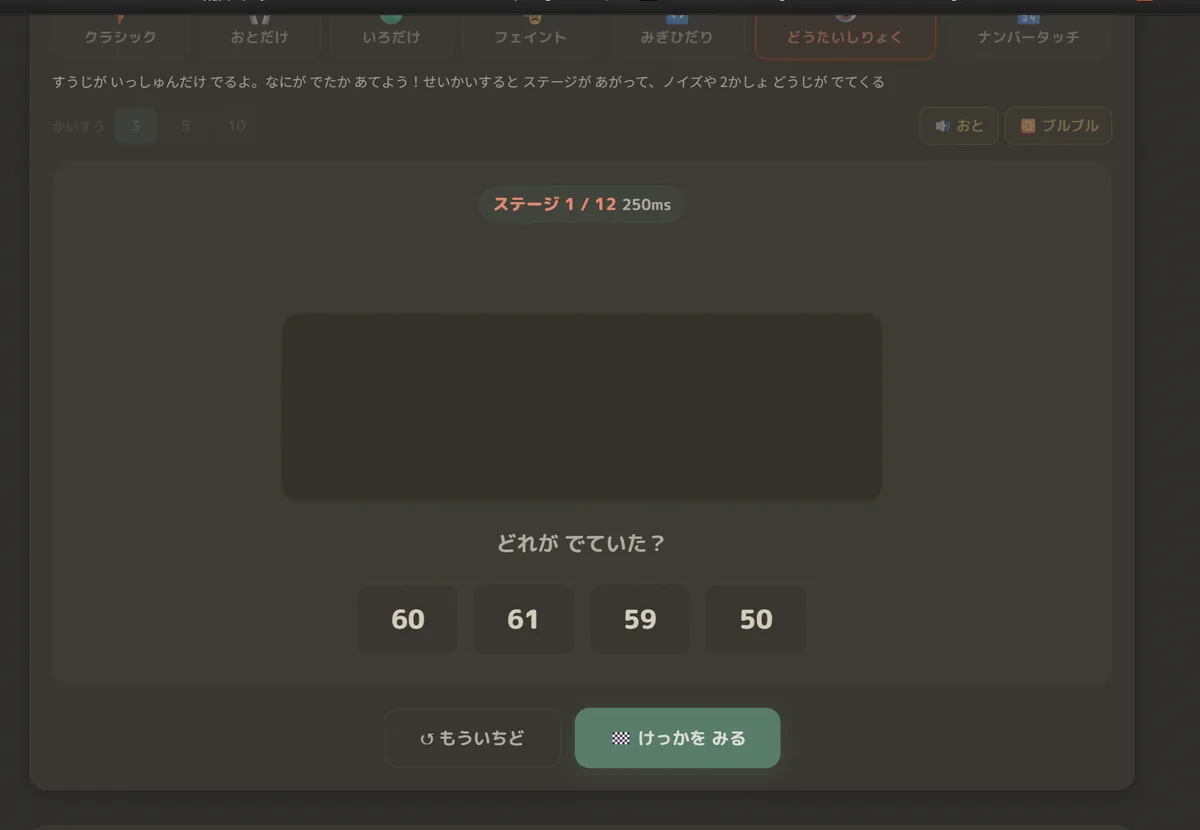
From stage 4, a noise pattern is briefly laid over the same spot immediately after the number disappears. This uses backward masking, and it makes the same exposure time far harder to read. Reviews of visual masking report that the interference is stronger when the mask resembles the contours of the target, and strongest when the interval between them is somewhere around 30–80 ms. The thing that came first is ruined by the thing that came after — that counter-intuitive quality is the heart of the phenomenon.
From stage 8, two numbers appear at once, left and right. Trying to chase both usually loses both. Resting your gaze between them and taking them in with peripheral vision sometimes works better.
What is measured here is not the same as a clinical dynamic visual acuity test. Dynamic visual acuity is a separate ability from static acuity, on the grounds that motion information travels a different pathway. In one report, students with static acuity of 1.0 or better still ranged from 0.12 to 1.30 on the dynamic measure.
Whether it can be trained is not settled. An eight-week training study with university baseball players, and a follow-up with junior high school students, both reported no improvement. Habitual kendo practice has been suggested as possibly slowing the age-related decline. Treat this mode as a way to check what you can currently see rather than as training.
Number touch — search, then move
Tap 1 through 25 in order. Instead of waiting for a signal, you are repeatedly finding a target with your eyes and moving your finger to it.
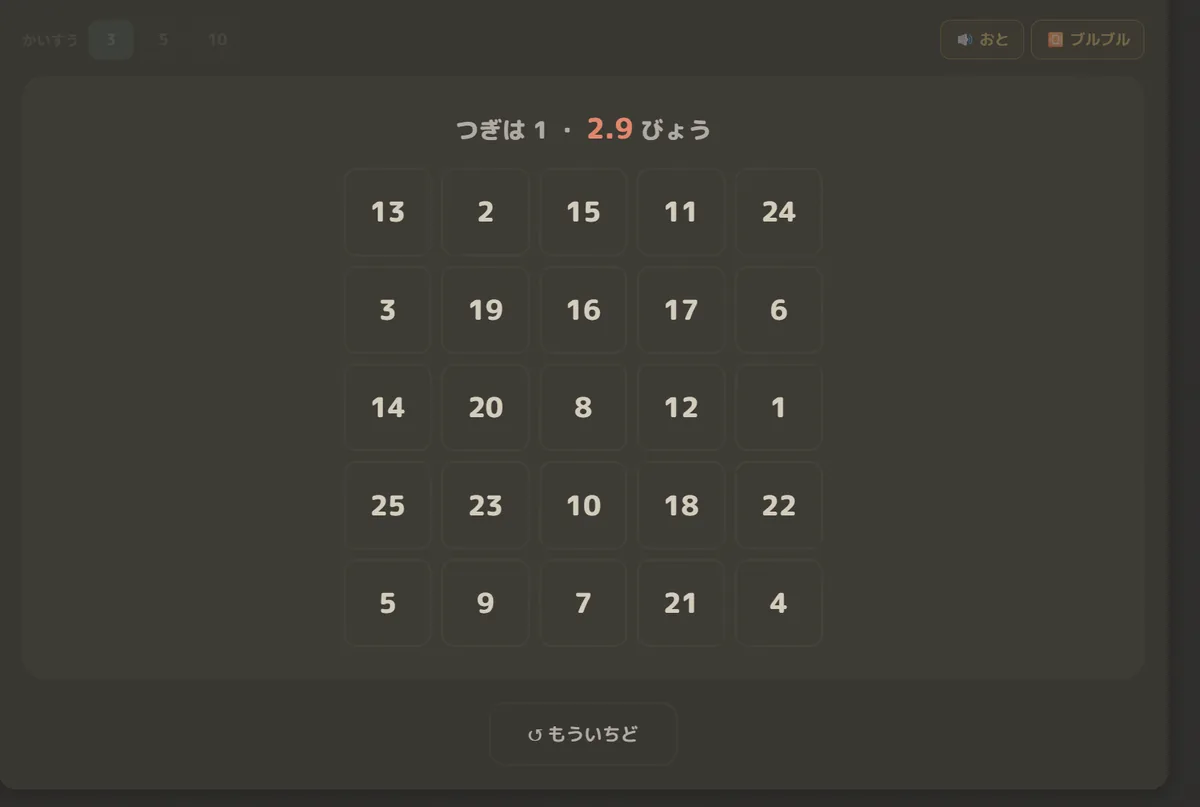
The other six measure what happens after a signal; this one runs at your own pace. The time goes into linking eye movement to hand movement, so it behaves differently from reaction time. Several people use it as a break between the other modes.
Which one to start with
- First time: Classic. It is the baseline for the others
- If sound is hard to hear, or you are somewhere quiet: Colour only. No sound, no vibration
- If the screen is hard to see: Sound only. Works with your eyes closed
- Practising for games: Left/right, then Feint. Judgement and inhibition enter
- Ball sports: Dynamic vision. Stage 4 onwards is where it starts
Try it
All seven modes, no sign-up and nothing to install. Records stay in your browser. The interface is Japanese, but the modes work the same way.
Open the reaction time test →Comparing your records
More modes means more ways to compare them wrongly. Three things.
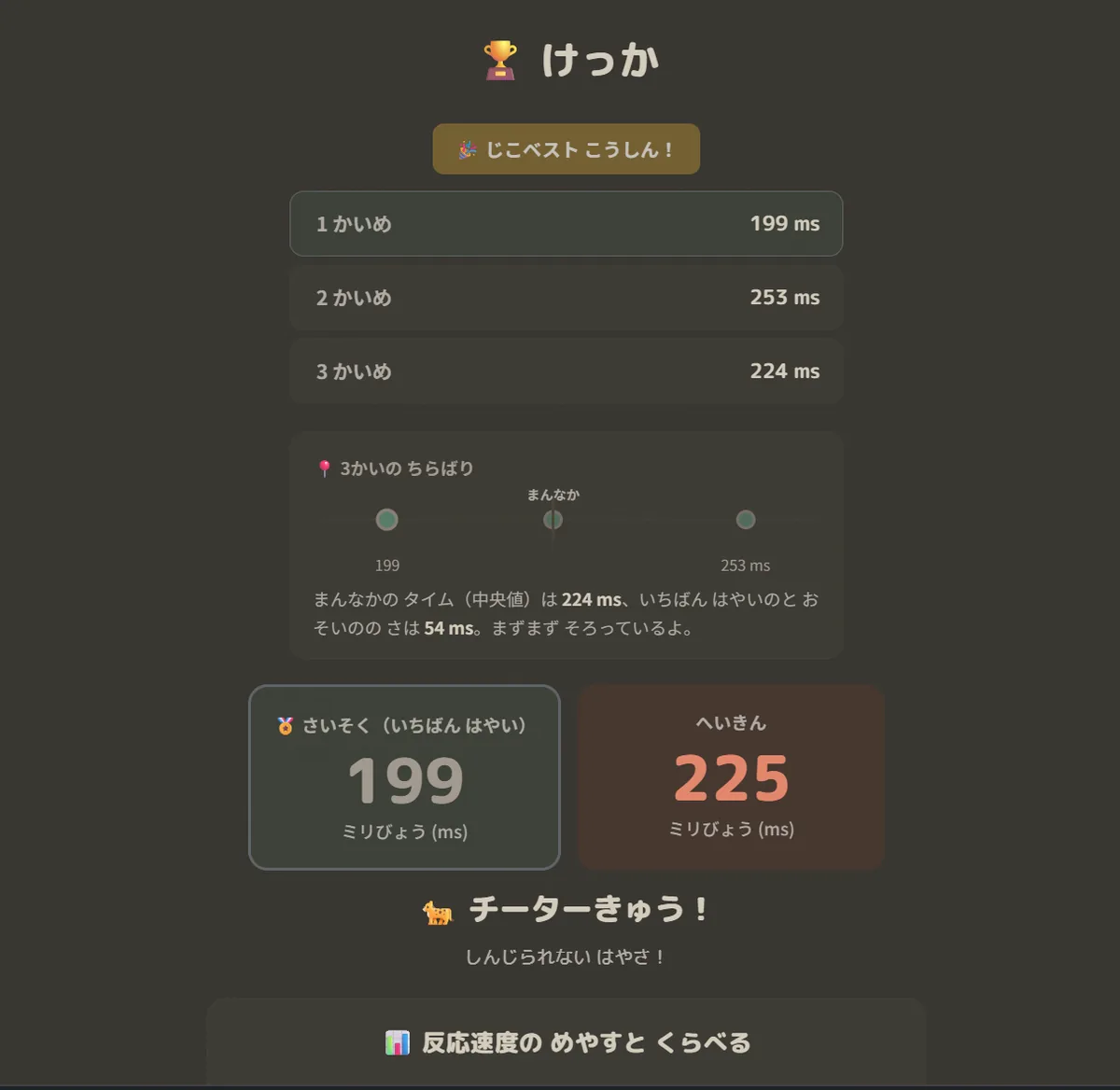
One: do not compare across modes. Classic and Left/right do not even have the same terms in the sum. Faster and slower only mean something within one mode.
Two: do not compare across devices. Measuring in a browser carries the delay of the screen refresh and the input handling. A phone number and a desktop number do not belong on the same line.
Three: how to read age. An analysis of 7,130 adults found that simple reaction time barely slows until around fifty, while choice reaction time keeps slowing throughout adulthood. Your Classic record holding steady while Left/right drifts is the expected pattern, not a fault.
Summary
- Reaction time is the sum of noticing, deciding and moving, so one number cannot tell you which part is slow
- Classic is simple reaction, Left/right is choice reaction. The gap is the deciding
- Feint is not about speed. It is about whether you can hold back
- The noise in the dynamic vision mode is backward masking. The same exposure becomes much harder
- Sound only and Colour only exist so that the same task remains possible when one channel is unavailable
- Compare only within the same mode on the same device
The bigger question — whether reflexes can be trained at all — I chased through the primary literature in a separate article. The short version: raw reaction speed barely moves. What moves is the part of the sum that contains a judgement.
This is one way of looking at it, and the research has limits. Reaction time values shift with stimulus intensity and apparatus, and some of the studies cited here do not have large samples. If something here does not match what you have seen, I would be glad to hear it through the contact form.
Sources
Simple and choice reaction time
- Woods DL, Wyma JM, Yund EW, Herron TJ, Reed B (2015) Factors influencing the latency of simple reaction time. Frontiers in Human Neuroscience 9:131 pmc.ncbi.nlm.nih.gov
- Woods DL, Wyma JM, Yund EW, Herron TJ, Reed B (2015) Age-related slowing of response selection and production in a visual choice reaction time task. Frontiers in Human Neuroscience 9:193 pmc.ncbi.nlm.nih.gov
- Der G, Deary IJ (2006) Age and sex differences in reaction time in adulthood. Psychology and Aging 21(1):62–73 pubmed.ncbi.nlm.nih.gov
- Donders FC (1969) On the speed of mental processes. Acta Psychologica 30:412–431 (translation of the 1868/1869 paper) pubmed.ncbi.nlm.nih.gov
- Wifall T, Hazeltine E, Mordkoff JT (2016) The roles of stimulus and response uncertainty in forced-choice performance: an amendment to Hick/Hyman Law. Psychological Research 80(4):555–565 pubmed.ncbi.nlm.nih.gov
Auditory versus visual
- Jain A, Bansal R, Kumar A, Singh KD (2015) A comparative study of visual and auditory reaction times on the basis of gender and physical activity levels of medical first year students. International Journal of Applied and Basic Medical Research 5(2):124–127 pmc.ncbi.nlm.nih.gov
- Pain MTG, Hibbs A (2007) Sprint starts and the minimum auditory reaction time. Journal of Sports Sciences 25(1):79–86 pubmed.ncbi.nlm.nih.gov
Response inhibition
- Verbruggen F et al. (2019) A consensus guide to capturing the ability to inhibit actions and impulsive behaviors in the stop-signal task. eLife 8:e46323 pmc.ncbi.nlm.nih.gov
- Verbruggen F, Logan GD (2008) Automatic and controlled response inhibition: associative learning in the go/no-go and stop-signal paradigms. Journal of Experimental Psychology: General 137(4):649–672 pmc.ncbi.nlm.nih.gov
Backward masking
- Breitmeyer BG, Öğmen H (2007) Visual masking. Scholarpedia 2(7):3330 scholarpedia.org
- Enns JT, Di Lollo V (2000) What's new in visual masking? Trends in Cognitive Sciences 4(9):345–352 pubmed.ncbi.nlm.nih.gov
Dynamic visual acuity
- Wu TY, Wang YX, Li XM (2021) Applications of dynamic visual acuity test in clinical ophthalmology. International Journal of Ophthalmology 14(11):1771–1778 pmc.ncbi.nlm.nih.gov
- Sawaki K, Kohmura Y, Aoki K, Nakamura M, Murakami S, Suzuki Y (2022) Sports and Kinetic Visual Acuity. Juntendo Medical Journal 68(4):387–392 pmc.ncbi.nlm.nih.gov
- Uchida Y, Kudoh D, Higuchi T, Honda M, Kanosue K (2013) Dynamic visual acuity in baseball players is due to superior tracking abilities. Medicine & Science in Sports & Exercise 45(2):319–325 pubmed.ncbi.nlm.nih.gov