Why so many children get stuck on long division
Long division (the column method), taught in the fourth grade of elementary school, is one of the most stumble-prone topics in all of arithmetic. The reason is simple: there are many steps, and it draws on every other calculation skill at once.
In long division you repeat "divide (estimate the quotient) → multiply → subtract → bring down" for each place value. For example, in "342 ÷ 19" you first think, "how many times does 19 go into 34?" (divide), then multiply, subtract, bring down the next digit, and so on. Multiplication, subtraction, and borrowing are all packed into this single loop.
In particular, when a borrow comes up at the "subtract" stage, the very same sticking point as column-method subtraction appears here too. Because there are so many steps, getting stuck at any one place throws off the answer.
If a child stays stuck on long division, it also affects their later study of fractions, decimals, and percentages. Yet textbook drills only show whether an answer is right or wrong, and it is hard to see which step the child is stuck on. That is the real problem.
Three causes of stumbling ── a view from the classroom
Once you can pin down "which step the child is stuck on," it becomes far easier to plan how to help. The reasons children get stuck on long division fall broadly into three groups.
- 1. The order "divide, multiply, subtract, bring down" hasn't set in
- Because these four steps repeat in a loop, children can lose track of the order partway through, or forget to "bring down" and freeze. The sheer number of steps is the first hurdle.
- 2. They can't "divide" (estimate the quotient)
- You need the skill of estimating "how many 19s fit inside 34." If the feel for multiplication is fuzzy, children put the quotient too high or too low, and the subtraction that follows no longer works out.
- 3. They stumble on the borrow in "subtract"
- Borrowing can happen even in the subtractions that come up in the middle of division. If the meaning of "borrowing" isn't understood, this is where their pencil stops. The same sticking point as column-method subtraction lies hidden inside division too.
Put the other way around: if you can break the steps apart one by one and make "where they got stuck" visible, you can focus practice on just that part.
Match the mode to "where they stumble" with three learning modes
SignCascade UD's "Column Method Challenge (Division)" lets you solve the same problem in three modes. Being able to pick a mode to match the stage of understanding is its defining feature.
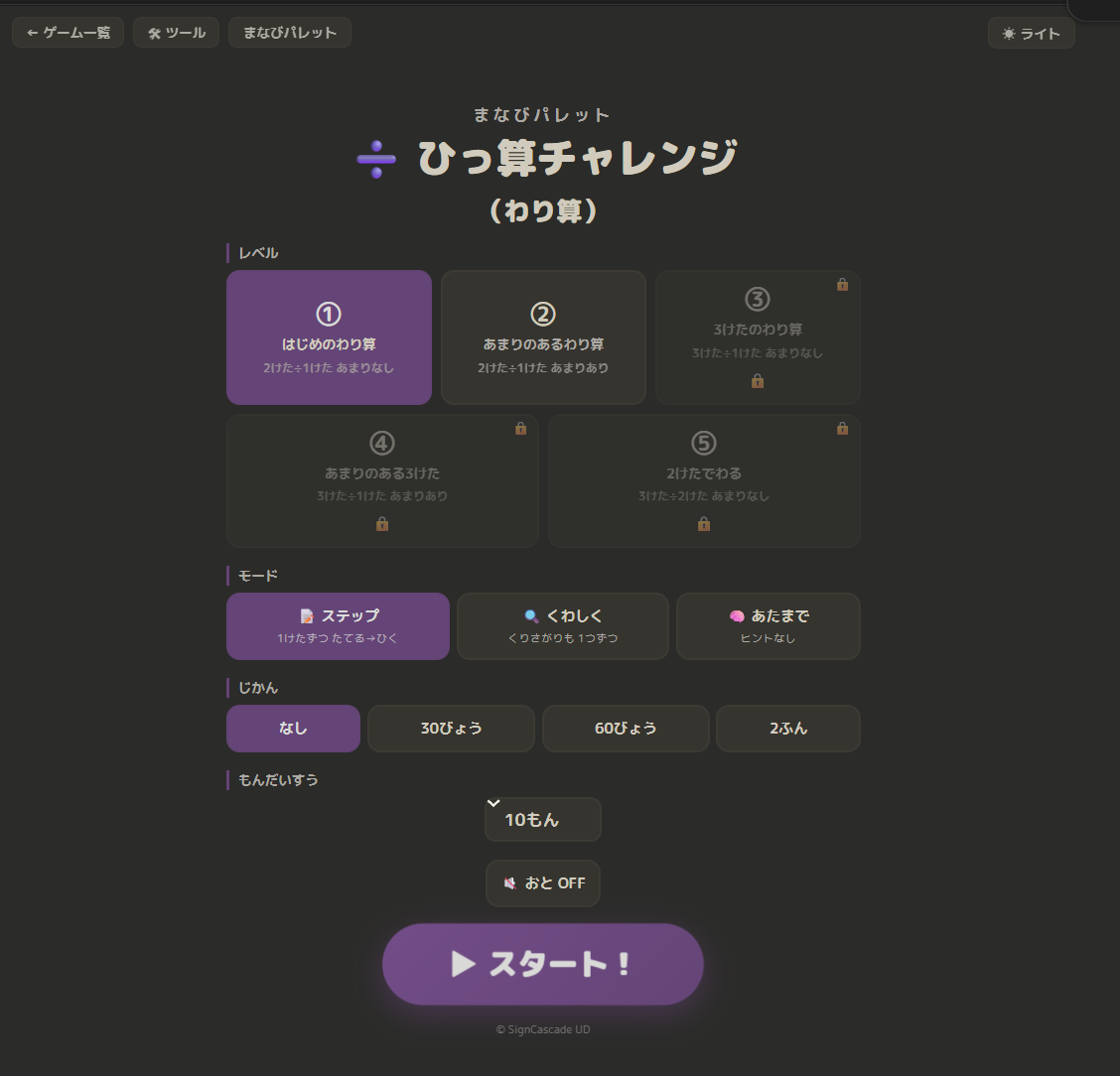
- 📝 Step mode ── guides the steps one digit at a time
- You enter "divide → subtract" one digit at a time, place by place. Below the board, the calculation to think about right now is shown in words, like "34 ÷ 19 = ?", so children can move forward with confidence by tracing the steps. Perfect for the very first step.
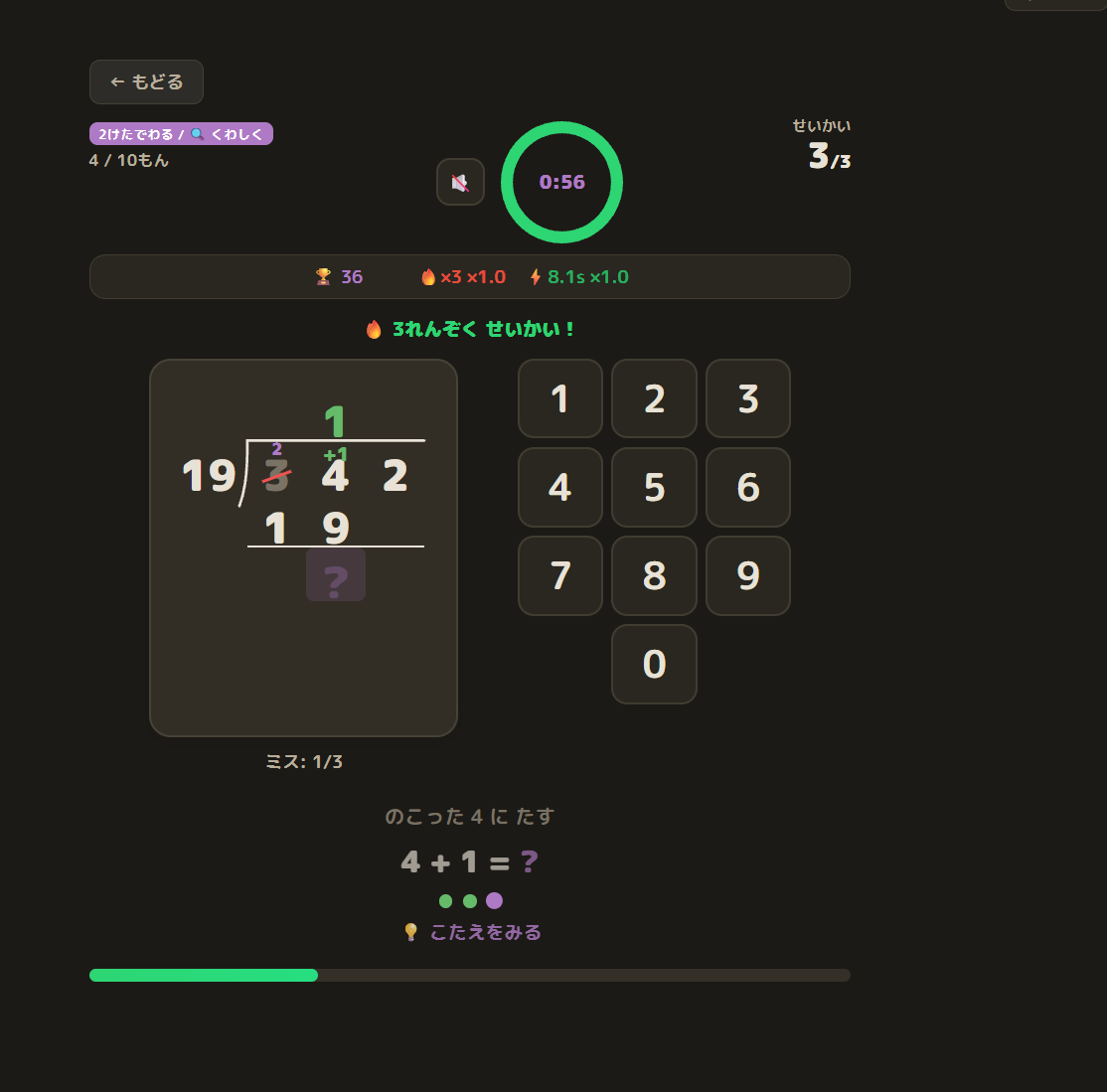
- 🔍 Detailed mode ── makes borrowing visible
- It makes long division's biggest sticking point — the borrow in "subtract" — visible one step at a time using the decomposition method. "Let's take 1 from the next place over" → a line is drawn through the digit in the borrowed-from place and the reduced number stays just above it → "subtract from the borrowed 10" → "add to what remains (+1)": each operation stays on the screen. Progress dots show which stage you're on, and if you get lost you can check with "💡 Show the answer." With the same care as column-method subtraction, children can understand borrowing from its very meaning.
- 🧠 In-Your-Head mode ── hide the hints and think for yourself
- The calculation prompts disappear, and you move forward with just the board and the cursor. Because children decide "what to calculate next" for themselves, it works as a check on whether the steps have set in, and as practice to build mental-math skill. Use it as the finishing touch after understanding with Detailed and Step.
What is "Column Method Challenge (Division)"?
It's a free browser game inside SignCascade UD. No install and no sign-up required — you can play it right away from a smartphone, tablet, or PC.
There are 5 difficulty levels. Starting from 2-digit ÷ 1-digit with "no remainder," it steps up gradually to problems "with remainders." Collecting stars at each level unlocks the next one.
- Three learning modes
- Switch between Step, Detailed, and In-Your-Head on the same problem. You can build the flow of understand → repeat → finish within a single game.
- Both with and without remainders
- As levels rise, problems with "remainders" also appear. You can check both the quotient and the remainder within the flow of the column method.
- Timer settings
- Choose from off / 30 seconds / 60 seconds / 2 minutes. You can also add a time limit to sharpen focus.
- Choice of problem count
- Choose from 5 / 10 / 15 / 20 problems. Go with 5 for a spare moment, or 20 when you want to practice thoroughly.
- Results screen and personal best
- Accuracy, combos, and more are shown, and your personal best is saved too. Children can feel their growth: "I can solve more than before!"
Column Method Challenge (Division)
5 levels, 3 modes — Detailed mode makes borrowing visible
Examples of use in the classroom and at home
- Personalized learning
- Identify that "this child is stuck at the with-remainder level," and have them practice just that stage intensively. Understand how borrowing works in Detailed mode, then repeat in Step mode — this flow is effective.
- Home study and self-directed learning
- Instead of a homework worksheet, tell them "do 10 problems on the Column Method Challenge," and they can move at their own pace. Having them show the results screen to a parent is another good way to use it.
- Use in special-needs classes
- In Detailed mode, children move forward while visually checking the borrow operation one step at a time. Because the "reduced number" stays behind the line, it's easier to grasp the image of "borrowing."
- Morning study time
- Open a tablet and work through the 5-problem mode, and it's done in about 5 minutes. It's just the right amount for a short morning slot.
- Pairing with the timer
- Work on it while showing a time limit with SignCascade UD's timer, and it turns into an exciting time-trial.
Advice for teachers and parents
To help grow your child's division skills, try keeping a few points in mind.
First, focus not on "where they made a mistake" but on "how far through the steps they can go". If they can divide but stop at subtract, you know borrowing is the challenge.
The order Detailed → Step → In-Your-Head is effective. If you have them practice with no hints from the start, it tends to become nothing but repeating right and wrong answers without understanding the steps. First grasp the meaning with "Detailed," repeat with "Step," and finish with "In-Your-Head."
Also, prioritize "solving accurately" over "solving fast". Because long division has so many steps, care comes first.
Division rests on the foundation of column-method multiplication and subtraction. For estimating the quotient there's Column Method Challenge (Multiplication), and for understanding borrowing there's Column Method Challenge (Subtraction) — using them together lets you fix stumbles right at the root.
Start Column Method Challenge (Division)
5 levels, 3 modes (Step / Detailed / In-Your-Head)
Column Method Challenge (Multiplication)
Practice column-method multiplication step by step — great for estimating the quotient
See other games
Times tables, hundred-square math, typing, time attack, and more